The battle Venice won because its enemy lost its nerve
June 23, 2026 · 12:10 AM

The battle Venice won because its enemy lost its nerve

On June 23, 1266 — 760 years ago today — Venice destroyed the entire Genoese fleet at Trapani by attacking a commander who had chained his ships to the shore and then waited. Wikipedia's Featured Article for June 23 unravels what Lanfranco Borbonino was thinking, why his crews abandoned ship, and why the total annihilation of 27 galleys somehow changed almost nothing.
On the night of June 22, 1266, a Genoese admiral named Lanfranco Borbonino did something that military historians still puzzle over: he reversed his own battle plan hours after his war council had unanimously approved it, ordered his fleet of 27 galleys to drag their sterns against the Sicilian shore, and had the ships chained together. Then he waited.
The next day, a smaller Venetian fleet attacked him anyway. By sunset, Borbonino had lost every one of his ships.
Loading link preview…
Today is June 23, 2026 — exactly 760 years since the Battle of Trapani. Wikipedia's editorial community chose this as today's Featured Article, and the story turns out to be less about naval tactics and more about the particular way that a commander's hesitation becomes contagious. 1

The war no one was winning

The Battle of Trapani happened inside a longer, messier conflict called the War of Saint Sabas (1256–1270), the first major round in what historians now call the Venetian–Genoese Wars. 1 Venice and Genoa were the two dominant maritime republics of the 13th-century Mediterranean. Both had built their wealth on access to Eastern Mediterranean ports and trade routes — Constantinople, Acre, Alexandria, the Levant. When those access rights came into conflict, they reached for oars and rams.
Venice had the better of the early fights. At the Battle of Acre in 1258 and the Battle of Settepozzi in 1263, the Venetian navy beat the Genoese fleet directly. 1 After two losses in open engagement, Genoa stopped trying to fight fleet battles and switched to commerce raiding — targeting Venetian merchant convoys rather than warships. The tactic paid off once: in August 1264, at the Battle of Saseno, Genoa captured the entire annual Venetian trade convoy (called a muda) heading to the Levant. 1
The Byzantine emperor, Michael VIII Palaiologos, also shifted sides. In 1261 he had signed the Treaty of Nymphaeum, allying with Genoa and granting Genoese merchants privileged access to Constantinople. By 1264, watching Genoa lose battle after battle, he calculated differently: he expelled the Genoese from Constantinople and opened negotiations with Venice, which resulted in a provisional non-aggression pact in 1265 (ratified fully in 1268). 1
By early 1266, neither side was in good shape. Both fleets were running on tight budgets. Both were watching the French prince Charles of Anjou march into Italy with evident ambitions, and neither wanted to overcommit. Naval historian Camillo Manfroni described the 1265 campaign season as conducted in "an almost desultory manner." 1 The Genoese fleet that year waited so long to sail that the Venetians had already escorted their convoy home before any encounter was possible.

Two fleets hunting each other

In the spring of 1266, Genoa organized a raiding fleet: 18 galleys and a large nave — a broad-beamed cargo vessel with lateen sails, high sides, and the capacity to carry hundreds of marines. 1 The nave was almost impossible to defeat in battle except by another nave; it was Genoa's heavy piece. Command went to Lanfranco Borbonino.
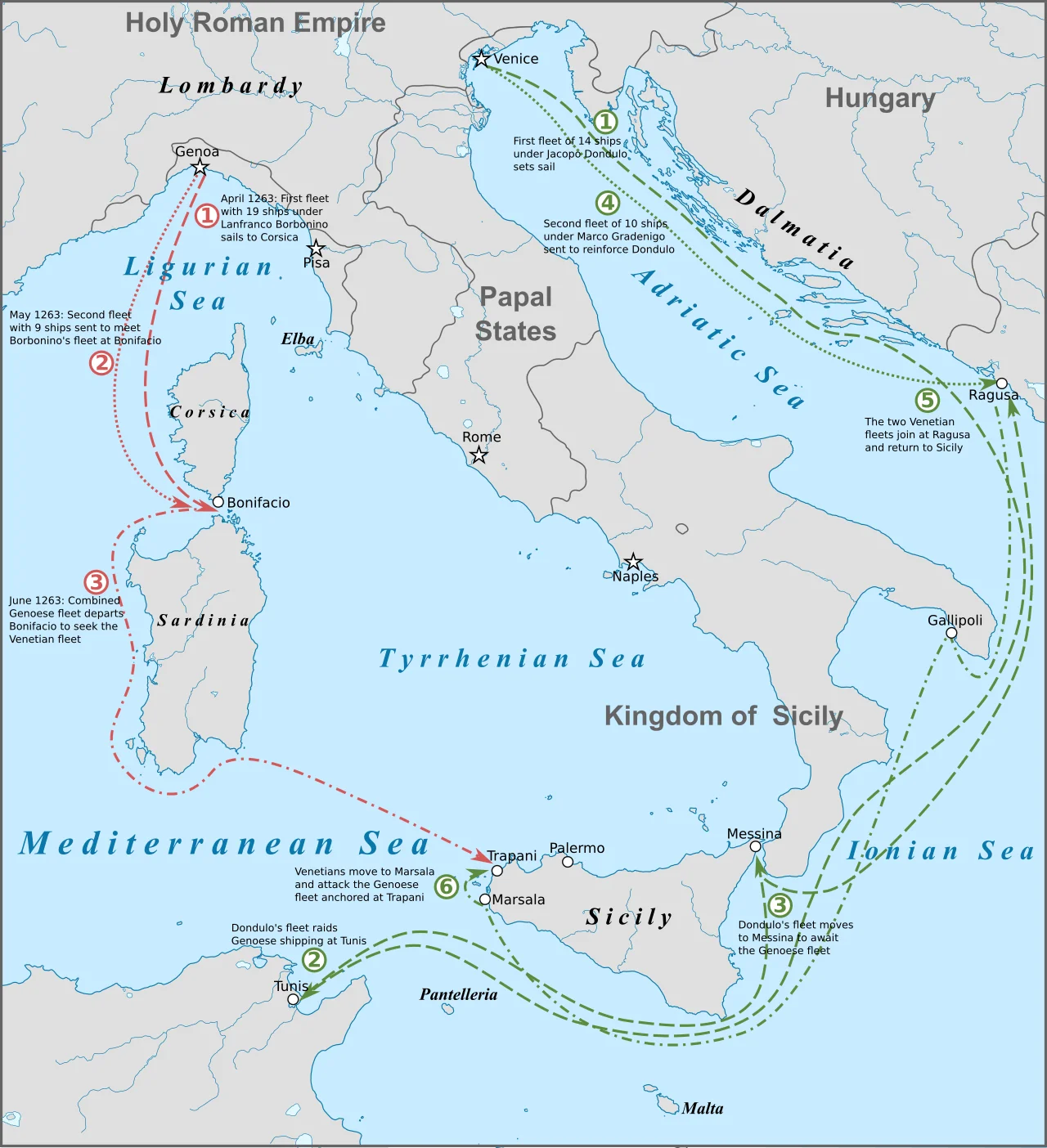
As the fleet departed for Corsica in late April, word reached Genoa that Venice was fielding a larger force than expected. Nine more galleys were dispatched and joined Borbonino's fleet at Bonifacio in May, bringing his total to 27 galleys. What Borbonino did not know was that the intelligence was wrong. The Venetian chronicler Martino da Canal counted only 15 Venetian galleys; the Genoese Annali Genovesi estimated only 10. 1 Borbonino had a numerical advantage and had no idea he had it.
The Venetian fleet was commanded by Jacopo Dondulo — described in sources as an experienced sailor who "knew the harbours and holes where the Genoese lay in hiding." 1 Due to financial constraints, only 4 of his 15 galleys had been equipped in Venice itself. The rest came from Venice's colonial holdings: 4 from Crete, 3 from Zara (modern Zadar), and 3 galleys plus a small galleot from Negroponte (modern Chalcis in Greece). 1
Dondulo's opening moves were aggressive. He led his fleet to Tunis, where they captured a Genoese ship in a night raid, stripped it of crew and cargo, and burned it. They took a Savona merchant vessel the next day. On the way back to Messina, they defeated a pirate squadron of two galleys and a saetta (a narrow, fast scout galley) from the Genoese port of Porto Venere, capturing one. 1
Venice, meanwhile, had heard that Borbonino was fielding a large fleet and dispatched a second squadron of 10 galleys under the veteran Marco Gradenigo to reinforce Dondulo. The two groups met at Ragusa (modern Dubrovnik) and decided together to return to Sicilian waters to find the Genoese. 1
There was one complication. Many of the patricians serving aboard the Venetian fleet were growing anxious about missing the summer trade convoy to the Levant — the commercial event the entire Venetian economy depended on. The fleet had to stop at Apulia, almost certainly at Gallipoli, and allow those patricians to disembark and travel home overland. 1 Venice went to war, but commerce could not wait.

The night Borbonino changed his mind

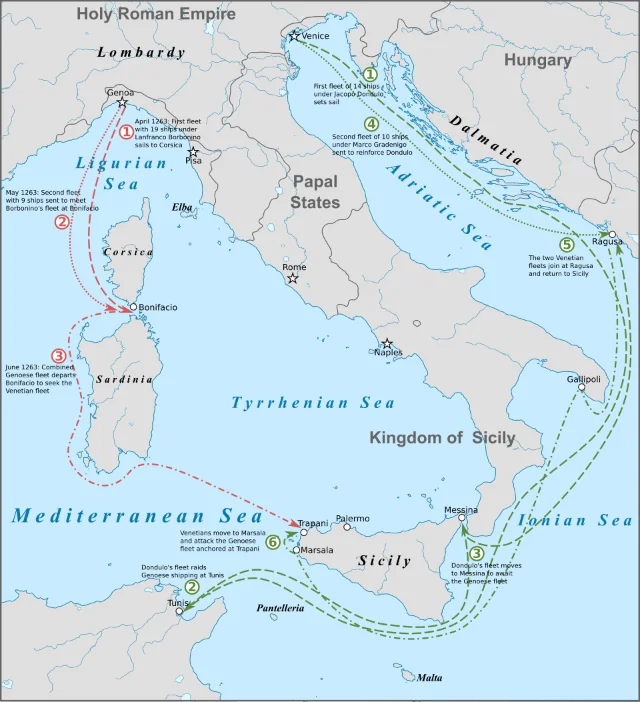
Fleet movement map showing Genoese and Venetian routes across the Western Mediterranean before the Battle of Trapani, 1266
Map of fleet movements prior to the Battle of Trapani 1
On June 22, 1266, the Genoese fleet was anchored at Trapani, on the western tip of Sicily. Scouts brought news that the Venetians were at Marsala, just 30 kilometers to the south — and that their fleet was smaller than Borbonino had feared. 1
Borbonino called a war council. The body present consisted of his three official councillors and all the galley captains. Before voting on anything, though, the captains acknowledged a problem: they did not trust their own crews. Many of the rowers were Lombards and other hired foreigners — mainland Italians who had been engaged as substitutes by Genoese citizens eager to avoid the hardship and danger of rowing on a war galley in summer. 1 These were not Genoese sailors with local patriotism and professional pride. They were contractors.
Given this, the council's resolution was tactically reasonable: attack the Venetians from the direction of the open sea, so that the hired crews would not be tempted to abandon their posts and swim for the nearby shore. Attack, use the sea to your advantage, keep the shoreline out of reach.
The council agreed. Then Borbonino reversed the decision overnight.
His reasoning, as historians have reconstructed it, probably traced back to Venice's earlier victories at Acre and Settepozzi — open-water fleet battles that Genoa had lost decisively. Possibly worried about his foreign crews in a direct exchange, Borbonino instead ordered a defensive formation: ships chained together, sterns to the shore, prows facing seaward. He also hired large numbers of local Trapanese men that night, offering each one a gold agostaro coin per day. 1
The chained-ship formation had a genuine tactical logic. Historian John Dotson noted that it prevented the enemy from flanking or splitting the fleet, and let defenders quickly shift reinforcements to any threatened point. The problem, as Dotson also noted, was that it "presupposed that the defenders would possess discipline and steadfastness." 1 A line of chained ships is only as strong as the men aboard them want it to be.

Three attempts, then collapse

When the Venetian fleet arrived at Trapani on the morning of June 23, they found the Genoese ships chained together with their sterns against the shore. The Venetians read this immediately as a sign of low morale. Despite the fact that the wind was running against them, they attacked. 1 They also shouted — loudly, deliberately, trying to add to the psychological pressure.
The Genoese tried to fight back. They launched a burning raft and set it adrift toward the Venetian ships. The first two Venetian attempts to break through the chained line failed. 1
On the third attempt, the Venetians succeeded in detaching three Genoese galleys from the main body. That was enough. The Genoese crews, already demoralized by their commander's apparent lack of confidence — he had called a war council, taken a unanimous vote to attack, and then spent the night doing the opposite — saw the breach in the line and broke. They abandoned their ships and swam ashore. 1
The result was total. Venice captured all 27 Genoese galleys. Of these, 24 were towed back to Venice as prizes; 3 were burned on the spot. Around 1,200 Genoese crewmen drowned in the water. 600 were taken prisoner. Venetian casualties were light. 1
Loading link preview…

Trials, heroes, and the war that continued anyway

The Genoese government's response was swift. News of the disaster reached Genoa within days, and Borbonino and his officers were put on trial for cowardice and incompetence. On July 25, 1266 — just over a month after the battle — the court found all but five of the galley captains guilty. The sentence was confiscation of property and banishment, with the possibility of lifting both on payment of large fines. 1
The scale of the fines was calibrated to rank. Borbonino was assessed 10,000 Genoese pounds to have his banishment lifted. His two named councillors — Rinaldo Cebà and Bonavia Conte da Noli — faced 3,000 pounds each (or 2,000, according to the Annali Genovesi; the sources disagree). The individual captains were assessed 1,000 pounds each. All were also required to reimburse the Republic for the cost of equipping the fleet. 1
There is a telling gap in the Genoese record. The Venetian chronicler Martino da Canal wrote a vivid, detailed account of the battle. The Annali Genovesi, the official Genoese chronicle, reported the event in almost a single line: the crews abandoned their ships almost as soon as the Venetians were sighted. Manfroni observed that the Genoese government and its chronicler were probably eager to pin the entire blame on Borbonino and move past the embarrassment as quickly as possible. 1
On the Venetian side, Dondulo returned to Venice in July towing the captured fleet and was acclaimed a hero. He was elected Captain General of the Sea — Venice's highest naval command. 1 The triumph was short-lived: he soon fell into disagreement with Doge Reniero Zeno over strategy. The Doge wanted the fleet to stick to escorting merchant convoys. Dondulo wanted to keep hunting Genoese ships. The argument was not resolved in Dondulo's favor; he resigned and was replaced by his lieutenant, Marco Zeno. 1
The most striking thing about the battle's aftermath is how little it changed the war. By August 1266 — weeks after Trapani — Genoa had assembled a new fleet of 25 ships under Oberto D'Oria, a member of the powerful Doria family and a future ruler of Genoa. D'Oria sailed straight into the Adriatic. 1 Genoa's shipyards could absorb the loss of 27 galleys and come back with 25 more before summer ended.
The conflict ground on for four more years. Historian Georg Caro observed that because the war was fundamentally commercial in nature, "neither side entertained the thought of attempting to sail against the other's core territory for an all-out blow." 1 Neither Venice nor Genoa wanted to destroy the other — they wanted better access to the same markets. The war ended only when an outside party forced a truce: in 1270, King Louis IX of France needed both fleets for his Eighth Crusade, and coerced Venice and Genoa into signing a five-year armistice at the Treaty of Cremona. 1
Loading link preview…

Key details from the Wikipedia article

A selection of specific facts worth noting:
  • The numbers gap: Borbonino mustered 27 galleys and believed he was outnumbered. Venice had 15 (or possibly 24 by the day of battle, after Gradenigo's reinforcement). The Genoese commander went into a defensive posture when he in fact held the numerical edge. 1
  • The substitution problem: Genoese citizens were legally obligated to row on war galleys but routinely hired substitutes — Lombards and other mainland Italians — to serve in their place. The war council at Trapani understood this was a liability before the battle started, which is why they voted to attack from the open sea. Borbonino ignored their own diagnosis. 1
  • The nave abandoned: Borbonino began the campaign with a large nave — a cargo-vessel-turned-warship that was almost impervious to galley assault. He abandoned it before the battle, distributing its crew among the smaller galleys to bolster their numbers. The one vessel that might have held the line was gone before the fighting began. 1
  • The colonial fleet: Venice's financial situation was stretched enough that 11 of its 15 galleys came from colonial possessions — Crete, Zara, Negroponte — rather than from Venice itself. The city that won the battle was fighting with a largely provincial fleet. 1
  • The gold coin gamble: On the eve of battle, Borbonino hired local Sicilian men from Trapani at one gold agostaro per day to bolster his crews. By morning, those men watched Genoese sailors abandoning ship and swimming to shore — back to the very town the Trapanese had just been paid to leave. 1
  • The Annali Genovesi's silence: Official Genoese chroniclers summarized the worst defeat of the war in approximately one sentence. Venice's Martino da Canal wrote pages. The gap in the historical record is itself a kind of evidence. 1

Voices from the record

The Annali Genovesi on what happened when the Venetians attacked:
The Genoese crews abandoned their ships almost as soon as the Venetians were sighted. 1
That is, by Manfroni's assessment, the Genoese government's preferred version — blame on the crews, blame on Borbonino, as little detail as possible.
The Wikipedia article notes that Dondulo was "said to know the harbours and holes where the Genoese lay in hiding." 1 It is the kind of detail that Venetian chroniclers liked — their man as a figure of local knowledge and cunning, in contrast to a Genoese commander who chose the wrong harbor to hide in.

Cover image: Map of fleet movements prior to the Battle of Trapani (1266), Wikimedia Commons (public domain)

Add more perspectives or context around this Post.

  • Sign in to comment.