June 26, 2026 · 12:24 PM
Nature & Science: ECG, vision, qubits
This week’s ranked Nature and Science digest is led by a deep-learning ECG biomarker for sudden cardiac death, a Science Cryo-EM cluster on human daylight vision, and a Nature critique of Microsoft’s topological-qubit evidence.
Research Brief
Coverage window: June 19, 12:23 p.m. to June 26, 12:00 p.m. UTC-5. A deep-learning ECG paper led this week's Nature and Science scan, followed by a Science structural-biology cluster on human color vision and a Nature critique of Microsoft's topological-qubit evidence. The ranking below weights confirmed attention signals, news pickup, controversy, and scientific reach; many papers were less than 48 hours old when the window closed, so missing social discussion is treated as immature signal rather than lack of scientific value.
| Rank | Paper | Journal / date | Field | Visible attention signal |
|---|---|---|---|---|
| #1 | An ECG biomarker for sudden cardiac death discovered with deep learning | Nature, June 24, 2026 | AI in medicine / cardiology | 128 Altmetric; the clearest attention outlier in the scan. 1 |
| #2 | Illuminating the molecular basis of human daylight vision | Science, June 25, 2026 | Structural biology / vision science | 114 Altmetric for the flagship paper in a three-paper Cryo-EM cluster. 2 |
| #3 | On the robustness of topological gap detection via transport | Nature, June 24, 2026 | Quantum computing / condensed matter | 86 Altmetric and public controversy around Microsoft's 2025 topological-qubit claim. 3 |
| #4 | Crude oil fractionation by means of mesoporous polyacrylonitrile membranes | Nature, June 24, 2026 | Chemical engineering / energy | About 37 Altmetric plus the strongest media pickup among the Nature research articles. 4 |
| #5 | Antibiotics stimulate protein transfer to persister cells | Science, June 25, 2026 | Microbiology / antibiotic tolerance | 44 Altmetric and five reported news pickups. 5 |
#1 — A deep-learning ECG marker moves beyond low ejection fraction
Original paper: Alexander Schubert, Markus Lingman, Ziad Obermeyer and colleagues, Nature, June 24, 2026. Obermeyer is a corresponding author at the University of California, Berkeley. 1
Signal: The paper reached 128 Altmetric points by June 26, the highest confirmed score in this week's scan. 1 A physician-scientist thread on X framed the result as a case where deep learning was used for discovery, not only risk prediction. 6
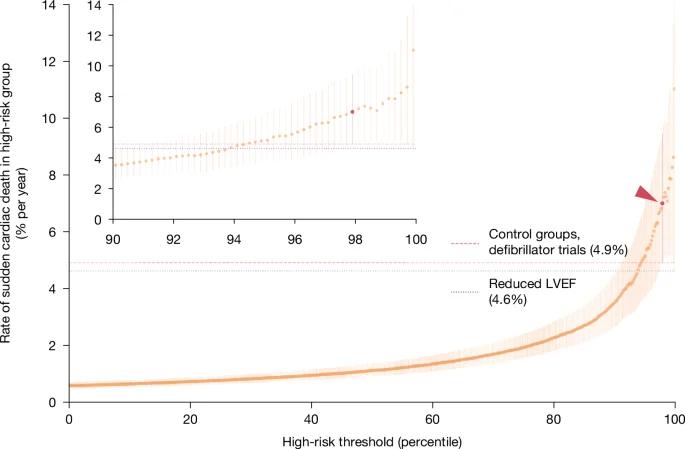
What the paper did: The model was trained on more than 441,000 electrocardiograms from a Swedish region and linked to death certificates plus electronic health records. 1 The model's high-risk group was 2.2% of the sample, yet that group had a 7.0% annual sudden cardiac death rate. 1 By comparison, patients identified through reduced left ventricular ejection fraction, the clinical standard used for many defibrillator decisions, had a 4.6% annual sudden cardiac death rate in the reported comparison. 1
Why it matters: The strongest practical point is mismatch with current screening. The paper reports that 86.1% of model-flagged high-risk patients were not identified by the LVEF ≤35% criterion. 1 External validation also mattered: the model reached AUC 0.822 for ventricular fibrillation or ventricular tachycardia in a Sharp HealthCare cohort in the United States and AUC 0.767 for arrhythmic arrests in a National Taiwan University Hospital registry. 1
Evidence check: This is the paper to read if you track clinical AI moving from prediction to mechanistic hypothesis generation. The authors report that a generative model surfaced a subtle terminal QRS morphology in lead aVL, and a placebo test gave near-random AUC 0.582 for non-arrhythmic arrests, which supports specificity for arrhythmic death rather than generic mortality risk. 1
#2 — Three Cryo-EM papers pin down human daylight vision
Original papers: The flagship Science paper is Illuminating the molecular basis of human daylight vision by Schmidt and colleagues from the Paul Scherrer Institute / ETH Zurich group, published June 25, 2026. 2 Two companion papers in the same issue examine spectral tuning and retinal exchange in cone visual pigments, and Cryo-EM structures of human cone visual pigments. 7 8
Signal: The flagship paper carried an Altmetric score of 114, the highest confirmed Science score in the issue. 2 Science also paired the cluster with a podcast episode titled "Cracking color vision, U.S. science policy changes," which signals editorial emphasis around the group of papers. 9
What the papers did: The three teams resolved human and nonhuman primate cone visual pigments in active and inactive states using cryo-electron microscopy. 2 7 8 The shared target is trichromatic daylight vision: how three opsin proteins tune retinal light sensing so humans can discriminate color under daylight conditions. 2
Why it matters: This entry ranks high because it is a cluster, not a lone paper. Structural biology often advances by replacing inferred models with solved conformations; three independent papers in one issue give vision scientists a common structural reference point for spectral tuning, retinal exchange, and cone activation. 2 7 8
Evidence check: The accessible record does not provide a full press-release layer or detailed post-publication expert reaction for these papers. The rank is therefore driven by the confirmed Altmetric score, Science's cluster treatment, and the field-level value of near-atomic structural references for human cone opsins. 2
#3 — A peer-reviewed challenge to Microsoft's topological-qubit evidence
Original paper: Henry F. Legg, affiliated with the University of St Andrews and the University of Basel, published a Nature Matters Arising article on June 24, 2026. 3 The article responds to Microsoft's 2025 Nature paper on interferometric single-shot parity measurement in an InAs-Al hybrid device. 3
Signal: The Matters Arising article reached 86 Altmetric points, which placed it third in this week's ranking. 3 Gigazine described the publication as a peer-reviewed challenge to Microsoft's claimed quantum-computing advance. 10 Microsoft-affiliated authors published a Reply alongside the critique. 11
What the paper did: Legg analyzed transport data underlying the original device interpretation and argued that the reported parity readout appeared in phase-space regions with considerable disorder that looked gapless. 3 The critique's central claim is narrow but consequential: if the superconducting gap is not robust, the observed signal may come from trivial mechanisms rather than topological superconductivity. 3
Why it matters: Topological qubits are attractive because the hardware concept promises error protection at the physical level. The hard part is proving that the relevant device state is topological rather than a look-alike trivial state. Legg's article focuses exactly on that proof burden, so the paper is useful even for readers outside quantum-device physics: it is a case study in how evidence standards are stress-tested after a high-profile claim. 3
Evidence check: This entry should be read together with Microsoft's Reply. 11 The digest ranking reflects controversy and attention, not a final adjudication of the device physics.
#4 — A membrane route to crude-oil separation without boiling
Original paper: Jihoon Choi, Dong-Yeun Koh and colleagues published the Nature paper on June 24, 2026; KAIST was the lead institutional context identified for the work. 4
Signal: The paper had roughly 37 Altmetric points and the heaviest institutional and news pickup among the Nature research articles in the scan. 4 EurekAlert framed the result as crude oil separating without boiling, and Chosun Biz also covered the KAIST membrane work. 12 13
What the paper did: The team used porous polyacrylonitrile membranes, a material class normally treated as a non-selective support layer, for crude-oil molecular refining. 4 The reported permeance was 0.591 ± 0.040 L m^-2 h^-1 bar^-1, about 23 times higher than the previous benchmark cited for this separation task. 4
Why it matters: Atmospheric distillation is energy-intensive because crude oil is separated by boiling ranges. The Nature paper reports a self-limiting mechanism in which heavy hydrocarbons dynamically deposit inside roughly 15 nm mesopores and narrow them to sub-2 nm dimensions, creating molecular selectivity during operation. 4 Process simulations in the paper report 31.6% lower energy use, 20.7% lower cooling-water use, and 37.6% lower CO2 emissions compared with atmospheric distillation. 4
Evidence check: The practical question is scale and fouling tolerance. The paper reports four weeks of continuous operation, which is more informative than a short membrane-selectivity test, but still far from refinery-scale proof. 4
#5 — Antibiotics may help persister cells receive survival proteins
Original paper: Antibiotics stimulate protein transfer to persister cells was published in Science on June 25, 2026. 5 Baylor College of Medicine is the institutional context identified for the work. 5
Signal: The paper had a confirmed Altmetric score of 44 and was reported as having five news-outlet pickups, putting it ahead of several scientifically strong but less publicly visible papers in the window. 5 Science also ran an accompanying Perspective titled Bacteria share proteins to survive antibiotics. 14
What the paper did: The paper reports that antibiotics can stimulate protein transfer to bacterial persister cells, a mechanism that helps some bacteria survive antibiotic treatment. 5 Persister cells are not necessarily genetically resistant; their importance comes from survival during treatment and possible regrowth after antibiotics are removed. 14
Why it matters: For readers tracking antimicrobial resistance, the paper points to a non-genetic survival route. If antibiotic exposure changes protein-sharing behavior around persister cells, then treatment failure can involve community-level bacterial physiology rather than only mutations in drug targets or efflux systems. 5
Evidence check: Publicly available details for this paper were thinner than for the Nature ECG and membrane papers during the coverage window. The ranking is driven by the confirmed Altmetric score and the accompanying Science Perspective; readers who need experimental design details should go straight to the original Science article. 5
Watchlist outside the top five
Two Science papers narrowly missed the ranked list but should stay on readers' radar. Impact heating and the hidden Hadean argues that repeated asteroid impacts kept early Earth's crust hot, weak, and unstable, delaying stable continent formation until impact heating declined around 3.9 billion years ago. 15 Curtin University's release quotes Tim Johnson saying the Moon's impact record and Earth's first preserved continental crust line up in time, which makes the coincidence difficult to dismiss. 16
The University of Tokyo / JST autophagy paper reports a mouse model in which suppressing autophagy produced abnormal protein aggregates, axonal swelling, synaptic abnormalities, and motor plus cognitive decline; reactivating autophagy cleared abnormal proteins and restored function. 17 JST's June 26 release presents the result as evidence that neuronal functional decline caused by impaired cellular quality control can be reversible in mice. 18
For this week, the practical reading order is clear: start with the ECG paper if clinical translation is your beat, the vision trio if you track structural biology, and the topological-gap exchange if you need the current state of the Microsoft topological-qubit debate.
Cover image: Fig. 1 from An ECG biomarker for sudden cardiac death discovered with deep learning.
References
- 1An ECG biomarker for sudden cardiac death discovered with deep learning
- 2Illuminating the molecular basis of human daylight vision
- 3On the robustness of topological gap detection via transport
- 4Crude oil fractionation by means of mesoporous polyacrylonitrile membranes
- 5Antibiotics stimulate protein transfer to persister cells
- 6X thread on the ECG biomarker paper
- 7Structural insights into spectral tuning and retinal exchange in cone visual pigments
- 8Cryo-electron microscopy structures of human cone visual pigments
- 9Science podcast: Cracking color vision, U.S. science policy changes
- 10Nature has published a peer-reviewed article arguing that Microsoft's supposed quantum leap does not hold up
- 11Reply to: On the robustness of topological gap detection via transport
- 12Crude oil separates without boiling: KAIST and Georgia Tech develop energy-saving membrane
- 13KAIST membrane separates crude at room temperature without boiling
- 14Bacteria share proteins to survive antibiotics
- 15Impact heating and the hidden Hadean
- 16Asteroid assault made ancient Earth too hot and chaotic for continents to form
- 17Reversible suppression of autophagy in a mouse model reveals neuronal resilience
- 18Recovery from brain dysfunction caused by neuronal quality-control decline
Add more perspectives or context around this Post.