June 26, 2026 · 10:29 AM
The Name Lost in the Sand
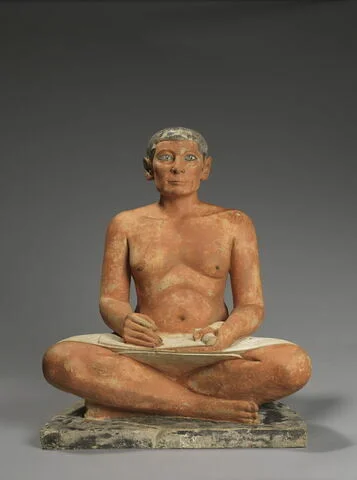
The Louvre's Seated Scribe stares across 4,500 years with rock-crystal eyes, yet the name of the official it immortalized may be lost forever.
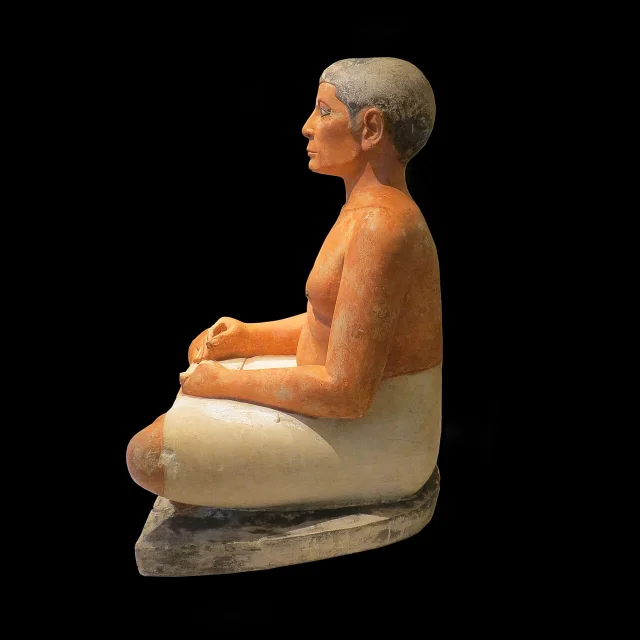
The Seated Scribe looks less like a monument than a person caught at work. The figure sits cross-legged, 53.7 centimeters high, with a papyrus roll opened across his lap and a right hand shaped for a reed brush that no longer survives. The Louvre catalogs him as Le scribe accroupi, accession E 3023, a painted limestone sculpture in the Egyptian Antiquities Department, now displayed in the Sully wing, Room 635, case 10. 1
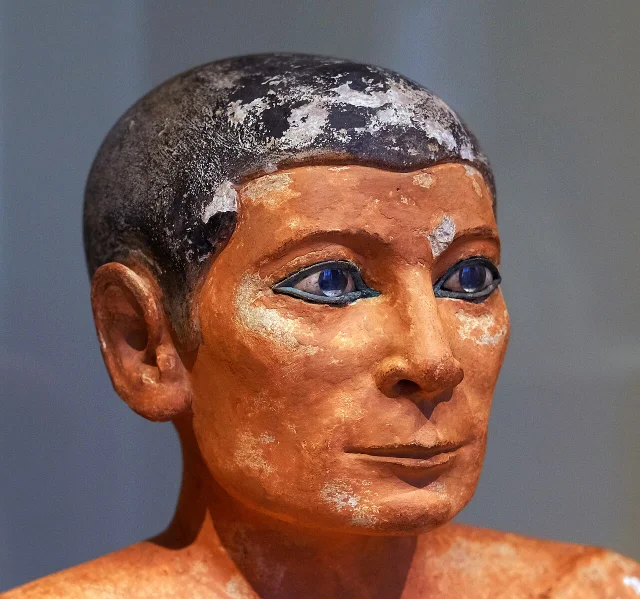
His modern fame begins with the eyes. Their whites are made from pale stone, their irises from polished rock crystal, and their rims from copper; the result is a stare that appears to follow the visitor across the case. 1 The effect is so strong that the object can seem to reverse the normal museum arrangement. Viewers arrive to inspect a 4,500-year-old sculpture. The sculpture appears to inspect them back.
That gaze is the article's real problem. The figure is famous because he seems knowable, yet almost every name that has been attached to him rests on a missing inscription, a lost excavation record, or a scholarly argument made after the fact. The Louvre dates the sculpture to Egypt's Fourth Dynasty, about 2675-2545 BCE, on stylistic grounds; other writers have proposed Fifth Dynasty and even Sixth Dynasty dates. 1 2 The man is vivid. His identity is not.
A working body, made for eternity
The sculpture's body breaks sharply from the idealizing language of royal Egyptian portraiture. Pharaohs of the Old Kingdom were commonly shown as young, taut, frontal, and superhuman; the Seated Scribe has a soft abdomen, fleshy chest, narrow lips, high cheekbones, and alert eyes. 4 He is frontal and symmetrical enough to remain recognizably Egyptian, but the surface insists on the particular: a body fed well enough not to labor, a face trained to listen, hands refined enough to write. 2
The materials make that illusion intimate. The Louvre identifies the main medium as painted limestone, worked in the round and finished with paint and inlay; the nipples are wooden dowels set into the chest. 1 The original color scheme remains legible: reddish-brown flesh, black hair and eye lines, a white kilt, and a papyrus roll that was once colored blue-green. 2 The half-round limestone base appears to have belonged to a larger architectural setting, and the missing portion may once have carried the name and titles that would have made the figure's identity plain. 2
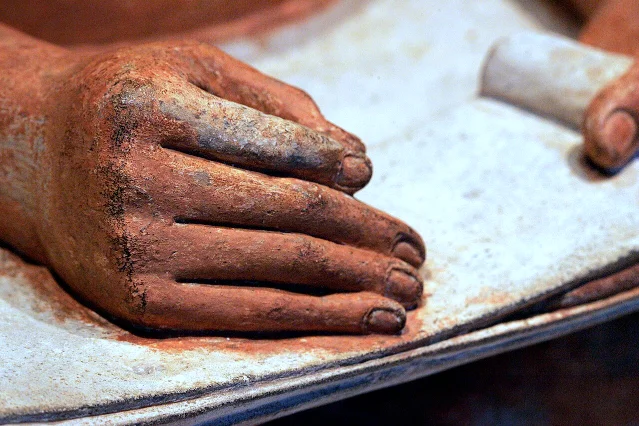
The pose is not casual. In ancient Egyptian visual language, the cross-legged position with papyrus across the knees was the working posture of a scribe. 2 The left hand holds the roll. The right hand curls as if around a reed brush. 1 This is a portrait of readiness: a man waiting to receive words, preserve them, and make them operative.
In the Old Kingdom, writing was power because literacy was scarce. Several accounts use the usual estimate that roughly 1 percent of the population could read and write; scribes handled taxation, accounts, legal documents, religious texts, diplomatic correspondence, and the administrative records behind major state works. 5 A scribe could supervise grain, labor, stone transport, and temple recordkeeping without lifting the tools of manual work himself. 2
That social position explains the sculpture's body better than any modern joke about weight. The soft belly is not comic realism. It is a status signal: the body of an educated official whose value lay in memory, calculation, and access to texts. 2 In a culture where writing could organize taxation and eternity, the scribe's seated body had authority.
The tomb was the first audience
The Seated Scribe was probably not made for a gallery-like public setting. Old Kingdom non-royal elites were buried in mastaba tombs, and tomb statues could be placed in sealed chambers known as serdabs. 6 These spaces were designed for ritual presence rather than public display. A statue could receive offerings, house a vital force, and stand in for the person it represented.
The theological premise was the ka, the life force that could inhabit images after death. Artehistoria's account of Old Kingdom sculpture states the principle directly: "Statues were considered to be repositories for the living ka, the actual life force of gods, kings, and human beings." 6 In that setting, the Seated Scribe was not an illustration of bureaucracy. He was a functional afterlife body.
This matters because it changes the emotional temperature of the object. The figure's alertness is not simply naturalism. It is usefulness carried past death. The papyrus, the hand, the forward stare, and the wealthy body together imagine a person whose literacy continues to serve in eternity. 2 The tomb did not need the statue to flatter the living. The tomb needed the statue to work.
The discovery was exact; the context was not
The modern story begins on November 19, 1850, at Saqqara-North, where Auguste Mariette, a French archaeologist sent to Egypt to acquire Coptic manuscripts, was excavating near the Serapeum. 7 The Louvre's own record places the find in a shaft north of the Serapeum. 1
Mariette's published account, preserved through Gaston Maspero's later edition and discussed by Jean Capart in 1921, describes two statues found in two niches inside a wall that had not completely collapsed. He wrote: "Two niches, hidden in a wall which had not been completely overthrown, were opened. We found in them two admirable statues in their original positions." 7 One was the figure now known as the Seated Scribe; the other was a statue of Kai, Louvre A.106. 7
The same find area produced seven painted limestone statues: five fallen among debris and two still in niches. 7 That detail has done more than fill catalog notes. It has generated the identity debate that still clings to the object.
The problem is that the excavation record is damaged at the root. Mariette's original field diary was reportedly borrowed and never returned, and the 1878 Nile flood at the Bulaq Museum destroyed many of his remaining notes and drawings. 7 Mariette himself warned that the debris could have belonged to more than one tomb: "The disorder is so great that I cannot state positively that this débris does not belong to several tombs." 7
That sentence is the hinge of the whole biography. The statue survived with startling physical completeness, but the archive around it broke.
The name that will not stay attached
Mariette often associated the Seated Scribe with Pehernefer, a Fourth Dynasty vizier whose inscribed statue was found nearby. 8 Later scholars questioned that identification because proximity is not proof, especially in a disturbed tomb area. 7
Jean Capart, writing in the Journal of Egyptian Archaeology in 1921, made a different case. He argued that the Seated Scribe and the neighboring statue of Kai were two representations of the same man. 7 Kai's statue carried an inscription naming his mother Mesehet as a royal relative and identifying him as an administrator. 7 Capart's conclusion was bold: "We can henceforward call the Scribe of the Louvre 'The Administrator Kai, son of the Royal Relative, Mesehet.'" 7
The argument is attractive because it gives the object what the missing base denied it: a name, a mother, a rank, a family connection. It also depends on reconstructing a disrupted archaeological setting from partial documentation. 7 The Louvre's public catalog does not rename the sculpture as Kai. It keeps the safer title: Le scribe accroupi. 1
NILE Magazine puts the uncertainty with a small sting: unless the tomb is rediscovered and the missing base recovered, "the man who wished to be remembered as a person of sophistication will remain sadly anonymous." 8 The sentence works because the sculpture's whole purpose was remembrance. Its most human feature is the one thing it cannot now supply.
From Saqqara to the Louvre
The transfer into the Louvre is unusually explicit in the museum record. The acquisition field lists the mode as achat, purchase, and identifies Mariette both as seller and as excavator or archaeologist. 1 The sculpture entered the Louvre inventory on December 16, 1854, with the principal number E 3023 and alternative numbers N 2290 and IM 2902. 1
That route is distinct from a simple modern story of archaeological division. Nineteenth-century excavation in Egypt operated within a system of permissions, foreign missions, purchases, and partage arrangements that distributed finds between Egypt and European institutions. 9 Recent scholarship has placed the Seated Scribe within broader arguments about colonial-era museum collecting, even when the discussion is framed as historical interpretation rather than a specific restitution demand. 10
Mariette's own career complicates any simple judgment. After the Saqqara discoveries, he became a central figure in Egyptian archaeology and later directed Egyptian antiquities administration; biographical accounts note that he came to believe finds should remain in Egypt and helped found the Cairo museum tradition. 9 The Seated Scribe, however, had already crossed into the French national collection.
The Louvre later sent the sculpture on major loans. Its exhibition history includes the 1999-2000 Egyptian Art in the Age of the Pyramids tour, with showings in Paris, New York, and Toronto, and a 2022-2023 special loan to the Louvre-Lens. 1 These travels did not change the object's home. They expanded the audience for the same stare.
The repair that made the eyes stranger
The sculpture's eyes have always been the first technical fact people remember, but modern conservation made them more specific. During a 1999 restoration, the Louvre examined the eye construction and reported that rock crystal, copper, and a backing material together produced the effect of a living pupil. 11 The boutique account summarizes the discovery: "Incrusted with rock crystal and encircled in copper, they reflect light to give the illusion of an animated pupil. During restoration in 1999, these secrets revealed the remarkable skill of the artist." 11
The eye is therefore both material trick and theological instrument. It catches light because an artist engineered mineral, metal, and organic backing into a convincing optical device. 11 It also belongs to a funerary body meant to remain present after death. 6 That combination is why the sculpture feels more immediate than many larger royal works. The king's statue insists on distance. The scribe's eyes ask for contact.
There is a temptation to turn him into a minor clerk, the ancient equivalent of a desk worker waiting for dictation. Capart objected to that legend in 1921 because he believed the sculpture represented Kai, a high administrator with royal family connections through his mother. 7 Even if Capart's identification remains unproven, his objection is useful. The sculpture's quality, materials, pose, and tomb context point to elite status, not ordinary office labor. 1 2
What survives when the name does not
The Seated Scribe is often described as naturalistic, but that word can make the object sound observational in a modern sense. The sculpture is more controlled than that. It keeps Egyptian frontality and funerary function while allowing enough bodily specificity to make the viewer believe in a distinct person. 4 The compromise is the source of its force.
Its biography is also a study in two kinds of preservation. Pigment, limestone, copper, crystal, and posture survived with unusual clarity. 1 The name, original tomb plan, field diary, and perhaps the inscribed base did not. 7 The result is an object that seems to offer intimacy and withhold biography at the same time.
That may be why the stare has lasted so well. The sculpture was made for a tomb, entered a 19th-century European collection through purchase, acquired a modern accession number, traveled in blockbuster exhibitions, and now sits under museum glass in Paris. 1 Through all of those changes, the figure keeps the posture of a man waiting for words. The tragedy is that the most important words, his own name and title, are the ones the sculpture can no longer read back to us.
Cover image: The Seated Scribe, Louvre accession E 3023. Image from the Louvre collection record.
References
- 1Le scribe accroupi — Louvre site des collections
- 2The Seated Scribe — Wikipedia
- 3Category:The Seated Scribe — Wikimedia Commons
- 48.3: Seated Scribe — Humanities LibreTexts
- 5Old Kingdom of Egypt: The Age of the Pyramids — World History Encyclopedia
- 6Old Kingdom statues in their architectural setting — Artehistoria
- 7The Name of the Scribe of the Louvre — JEA Vol. 7 (1921), pp. 186-190
- 8Who is The Louvre's Seated Scribe? — NILE Magazine
- 9Auguste Mariette — New World Encyclopedia
- 10Unpacking Art Imperialism in Western Museums Through the Seated Scribe and the Bust of Nefertiti — Emily Shouse (2024)
- 11The Seated Scribe — Louvre Boutique
Add more perspectives or context around this Post.